The Final

Goal of the Final Presentation

In the last week of the class, we get to bring together everything we have learned and worked on throughout the semester via startup pitches to a panel of investors. This semester, we learned about ideation, customer discovery, problem-solution fit, market and sales strategies, business and revenue models, unit economics, and financial projections. It was a lot to fit into one semester but through actually walking through each step with our own startup ideas, we were able to really understand what each piece of the startup puzzle requires and the amount of time and energy that have to go into the logistics on top of the actual product creation. This final pitch gives us a chance to bring everything that we have learned together in one presentation and also allows us to practice pitching to investors.

Our Journey

As I worked with my team on creating a final presentation, I couldn’t help but think about how far we had come since the beginning of the semester: all the hurdles we faced and the pivots we made that led us to this final presentation.
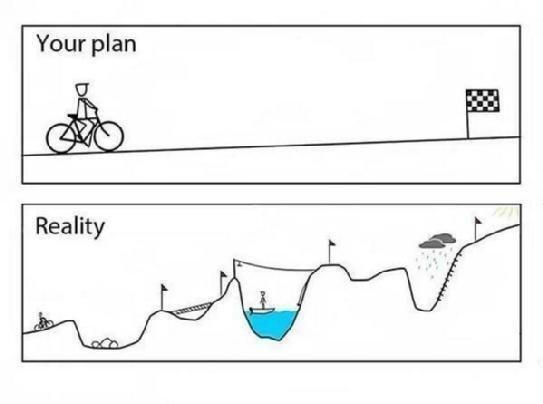
Dennis R. Mortensen on Twitter: "Your #startup plan vs. reality ...
https://twitter.com/dennismortensen/status/462225347946110976

We started with the innovative idea of crowdfunding for local businesses. For local businesses, this would act as a quick loan, while townspeople could invest their money in a way that would give them returns while also allowing them to give back to their communities. But upon doing customer discovery in Gate 1, we realized that this was an extremely complicated idea and enticing people to invest in local businesses that aren’t doing so well would prove to be difficult. This, in addition to the fact that our “CEO” who had previously thought of this idea had decided to drop out of the class, led us to feeling the need to pivot. As we neared the Gate 2 deadline, we realized that we needed to land on a solid idea so the remaining team members, Shreyas, Max, and I, met at Cafe Strada and went through nearly 20 different ideas before thinking about having a storage closet with common cleaning supplies in apartment buildings that can be loaned via a subscription service. However, our mentor was quick to shut us down on this idea and gave us the idea of just moving to a simpler portfolio management service whose value propositions would be guaranteed returns, thereby neutralizing the risk of investing. We took this idea and decided to run with it, especially given how close it was to the work we did in Gate 1.

Based on the comments from the professors and mentors during Gate 2 presentations, we decided to narrow our target market even more to college students, a population that wanted to start investing but did not have the knowledge to create high performing, low risk portfolios on their own.  We further refined this idea for our Gate 3 presentation where we created financial projections and tailored our marketing strategy to our new target market. 

Bringing Everything Together

Our journey has been long and not at all simple as we faced changes to our idea and to our team. But all of this brings us to today – bringing everything from all of these gates and all the work we did in the past together in one cohesive presentation, this time to a panel of investors. After our Gate 3 presentations, we were tasked with putting all of our material and research together to create a one-pager and a pitch deck for our startups to be presented to a panel of real investors. We will get the opportunity to not only hear new opinions from fresh eyes about our ideas but also get the chance to practice pitching and creating appealing presentations and one-pagers; skills that we will definitely need when we actually embark on our entrepreneurial journeys.

Takeaways from the Class

This is one of the few classes where I feel like I have genuinely learned a lot on one topic. Most classe focus on a only subsection of a topic, such as the class I took last semester on venture finance in which we only really learned about the topics covered in Gate 3. But in this class, we got to cover everything, which I believe was a valuable experience. We talked about:

  1. Ideation and pitching preliminary ideas to our classmates.
  2. Then we talked about customer interviews. We learned about problem-solution fit and making sure that our startup ideas were solutions to problems that people genuinely face.
  3. From there, we moved into different marketing and sales strategies and growth opportunities. Here, it was important to define a business model so we looked at different types of revenue models that apply for different types of businesses.
  4. Finally, we expanded on the finances of our businesses and made assumptions about costs and revenues and made 8-quarter and 5-year projections about where we see our businesses going and how we expect it to grow.
  5. Lastly, we get the opportunity to actually pitch our ideas to investors. This is an invaluable experience that not many students get in a classroom setting, which is one of the things that I so appreciate about this class.

This class also taught me about the importance of leadership. When our leader left us right before our Gate 1 presentations, we stepped up to fill in his shoes and finish what we started. And when it came to the following Gates, I felt myself take on leadership by making sure everyone remembered our deadlines and creating the outlines for presentations and splitting up work amongst all of us. I feel that I have taken a major role of responsibility throughout this project, especially during Gate 3 as my team members had little experience with financial projections and venture finance compared to me. Also, given that we all left campus due to coronavirus, it made it a little bit more difficult to communicate and ensure everyone was doing their share, but we made it work in order to make, what I believe, will be a convincing final pitch.

I also want to thank the instructors and the mentors for everything they have taught us throughout the semester and all the time and effort they have put into helping us with our startups and presentations. I can definitely say I have come out of this class having learned a lot and am very thankful for that!

#ieor191 #finalpitches #entrepreneurship

Gate 3

Goals of Gate 3

Gate 3 focuses on the financial aspect of our startups. Now that we have all come to our decisions about our ideas, problem-solution fit, marketing and sales strategies, and revenue models, we can now determine our financial models. In this gate, we were asked to come up with our unit economics, eight quarter projections, and five year projections. Through this exercise, we had to understand assumptions about our business, such as pricing, profit margins, number of customers per period, variable costs, and fixed costs.

Finding Information and Assumptions

The first step in creating our unit economics and financial projections was to understand the assumptions needed. We need to think through the costs and revenues that we would incur. From our platform, it was pretty simple to determine what types of revenues and costs we would have:

  1. Revenues are the investment of the money managed
  2. Costs include many things such as:
    1. The dividends repaid
    2. Employee wages
    3. Office space, and
    4. Legal fees.

We found these numbers by estimating the number of customers we would have per period based on the trajectories of similar companies like Robinhood and also by estimating our needs in order to handle the surge in customers over time. We used resources like checking WeWork’s fees and legal firms in order to further specify our costs. We also made certain assumptions about the amount of money college students would be able to invest based on demographic averages and applying what we had seen with ourselves and our peers.

Verifying Attractiveness to Investors

After determining our assumptions and finding relevant information, we had to check whether or not it made sense in terms of the amount of money we managed over time, how our costs changed over time, and whether or not the final net income figures seemed to make sense. It is not just about understanding whether or not these figures would intrigue investors and convince them to invest. We adjusted our numbers based on what the professors have explained in class about what a range of good numbers is for investors.

Presentation

This was by far our best presentation and there was very little that the professor and mentors had to say about improvements that could be made. We worked hard to check our assumptions and make sure our models were feasible. That they would be attractive to investors – possible but not an exaggeration.By thoroughly understanding what goes into a company like this, we were able to better present it to our class, the professor, and the mentors.

Takeaway

Gate 3 was by far the most interesting gate for me to work on because as an economics student, I have learned a lot about financial statements, such as the profit and loss statement on which we created our financial projections. This is my opportunity to put what I had learned in my classes to practice. As the only one in my group with prior experience with finance, I really got to take the lead on this gate, helping my teammates through this presentation. It was also a good way to understand researching similar startups and helped me to learn more about the condition and growth of companies in this sector.

Looking forward, I am excited to bring together all three gates to make a final pitch presentation for investors. The work we have done in these gates has helped us understand what is needed to plan out a company and pitch to investors.

#ieor191 #gate3 #entrepreneurship

Gate 2

GOALS OF GATE 2

Today, we presented our gate 2 presentations to the class, the professors, and our mentors and then proceeded to receive feedback on our presentation. Gate 2 is all about the marketing and sales plan for our companies. Based on the startup ideas we introduced in Gate 1 and the market research and customer interviews done, we should have identified a target market and identified our problem-solution fit. Gate 2 is about taking our ideas a step further, identifying how to bring our product to our target customers and our preliminary ideas for revenue streams and how to grow over time.

A Recap of Our Group’s Journey

There is no road without bumps. Our road from Gate 1 to Gate 2 was bumpy to say the least.

  1. Complex ideas are hard to execute, including having a two-sided platform where the customers on both sides seemed to be opposing what they wanted from each other. We were trying to pair distressed businesses with investors who cared about their community. But the investors wanted security in their investments and the distressed businesses were too scared to take on debt from their customers. Based on this, we decided the idea was not going to be the best to go forward with – we needed to pivot.
  2. Ideation is not the easiest thing to do in a time crunch. After deciding we had to pivot, we found ourselves in a tight spot, trying to figure out what we could change too. We went through a list of nearly twenty ideas until we landed on one – a closet of high quality common household items placed in every apartment building that can be rented out by anyone living in the building. But before completely getting into the idea, we wanted to run it by our advisor first.
  3. Some ideas are better than others. When talking to our advisor about our new idea, he almost immediately shut us down. Within seconds of us finishing our pitch, he responded by telling us that we were on the right track with our first idea, we didn’t need to pivot so far from the original idea. He helped us reform our idea to be closer to a portfolio management service platform.

As a team, we have gone through a lot of hiccups in the road. But I’m glad that we have finally settled down with a viable idea that we all believe in.

A Final Solution

We decided as our final idea we would look into creating a low risk portfolio management service. We want to be able to target people who are risk averse with a low barrier of entry and little knowledge about investing. We want to help the people that don’t normally get help with investing and growing their money in a safe way. 

Because we spent so much time between Gate 1 and Gate 2 working out how we would pivot, we were in a crunch for time trying to get Gate 2 prepared for our new idea. It was interesting to research competitors and similar platforms to see what they do, their business models, and how they grew over time. I learned a lot about how much money was required to build platforms like this. We decided that we wanted to target college students as a starting point and slowly grow to all demographics and market to them to help directly with their needs. For example, we wanted to help college students be able to grow their tuition money, and older adults be able to plan and save for retirement. We even began to write out a preliminary timeline and financial projections too, estimating how we would do and how feasible it would be to gain traction.

Conclusion

What came out of our Gate 2 presentation was an interesting point of view that the professor had. We had originally said that we wanted to start out by helping college students and then expanding to larger demographics as we were able to get a hold on our product. But the professor thought that we meant to help college students invest their money safely so it would grow enough between each semester to be able to pay for tuition. This is an interesting idea, a more narrow target market, that I am looking forward to digging into. Investing in super safe securities often leads to low returns, which may not be enough for some college students who are looking to grow to be enough to pay thousands of dollars of tuition.

#ieor191  #gate2 #entrepreneurship

Gate 1

OVERALL GOALS OF GATE 1

Today marks the day we finish the first Gate of this class and is a major checkpoint for our projects and the progress in our startup ideas. This whole gate was centered around finding a problem that people face in the world attempting to create a novel solution that fits the problem. It involved a lot of thinking about the types of problems people face and self-reflection about what we are passionate about and what we want to work on. After figuring this out, we moved into preliminary research on the idea and customer discovery via interviews.

IDEA GENERATION

For me, this whole process has been a rollercoaster in many different ways. I was extremely excited on the day of project proposals because one pitch in particular really piqued my interest.

The idea was an investment platform that would allow community members to invest in local businesses who need a loan and would eventually receive returns on their investment. 

Immediately after hearing the pitch I knew that was the project I wanted to work on and I was glad that someone had presented an idea that I was genuinely interested in pursuing. But it turned out that I was not the only one interested in the idea, so were five other people and the group size couldn’t be larger than four. However, I fought hard for my place in the group by sharing my passion and experiences that could lend a hand to the project and I got it! That was probably the best point of this entire project. What followed was a number of difficult and more difficult points in the journey.

INTERVIEWS

Our next task was to work on customer validation and product solution fit with interviews. This was difficult, put simply. 

  1. First, our platform is two-sided which means that there were two types of customers we had to address – small businesses and investors. It is easy to approach individuals between the strangers we meet around the city and the people we know personally in order to gather data on what people want from an investment platform that allows them to give back and participate in their community. On the other hand, it is very difficult to get a hold of small business owners, let alone trying to get them to speak about their financial situation and their willingness to get a community loan.
  2. The second difficulty we ran into were the questions themselves. It is hard to get customers to open up about their problems in a way that reveals if our platform is a good fit without leading them by directly asking them about the platform. It took a lot of redoing to reach a point where we had good questions that got us enough information.
  3. From this, we ran into our next problem – investors want a high level of security in their investments, which is difficult to deliver a platform catering towards struggling businesses. This creates a major feasibility problem with the platform that honestly would be really hard to pull off, which concerned the whole team and began a discussion of pivoting to a new idea. We decided to continue with our current idea and do a little more research for now.

ANOTHER PROBLEM

And then we received the biggest difficulty of all – our CEO, the person who generated the idea, who had previously done a lot of background research on the idea – decided to drop the class. This lead us to completely reconsider the idea. Can we continue this project without him as a group of only three people? Would we be able to start a new idea just us? Should we split into new groups? There is a lot to consider and it is something we are still trying to figure out. I guess we’ll just have to see what happens from here. Personally, I hope we can stay with our group and easily pivot to a simpler idea.

#ieor191 #gate1

Week 01

Rhea Sali

MY FIRST IMPRESSIONS

After having sat in this class (Tech Entrepreneurship) for the first time last Thursday, I can say with confidence that I am truly enthusiastic by the future of this course. It is exciting to know that the lecturers are experienced in entrepreneurship and have worked in or with multiple startups in the past. That experience will be an integral part of the class as it will allow me and the other students to learn from their successes and their failures. It will be helpful to have such knowledgeable resources within the classroom. My favorite part of this first class was the final pitch presentations by the Korean students. If they were able to come up with ideas for startups and create pitch presentations of the quality we saw on Thursday within two weeks, I can only imagine what we will be able to accomplish in fifteen weeks. It was also helpful to see firsthand the kinds of questions and comments the judges were making as it gave perspective into what they were looking for while grading the presentations.

MY GOALS

I am a junior currently pursuing a double major in Economics and Data Science and the SCET Entrepreneurship and Technology certificate. I am doing this because my goal is to eventually be working at a venture capital firm, funding startups with the aim to help them change the world. I personally do not have the particular ambition of starting my own startup, but with the goal of helping other startups via funding in mind, I believe it to be of the utmost importance that I understand what goes into creating a startup. If I learn the inner workings of a new company and the processes that founders go through to reach success, it will no doubt help me when making decisions about funding new companies. Further, by being in a classroom surrounded by established and budding entrepreneurs, it will give me a good glimpse into the mind and thought process of a founder. Having this knowledge and empathy will help me understand the people I will be working with in the future. I strongly believe that these are important skills and traits of a good investor, which is why I am so excited about taking this class.

MY EXPECTATIONS

Looking ahead at the syllabus, I am interested to see how the instructors break down each piece of the startup puzzle from ideation all the way through to valuation and investment pitches. I know that for the most part, the process of creating a company is more spontaneous and not as structured as this course, so it will be interesting to see everyone starting companies in this manner. Hopefully, it will help to have some students who have already reached the idea generation/ problem solving stage. I am looking forward to this week when my peers begin pitching their ideas and the problems they want to solve. I am eager to see the innovation within the classroom and what ideas I could possibly work on for the foreseeable future. 

#SCET191

Design a site like this with WordPress.com
Get started